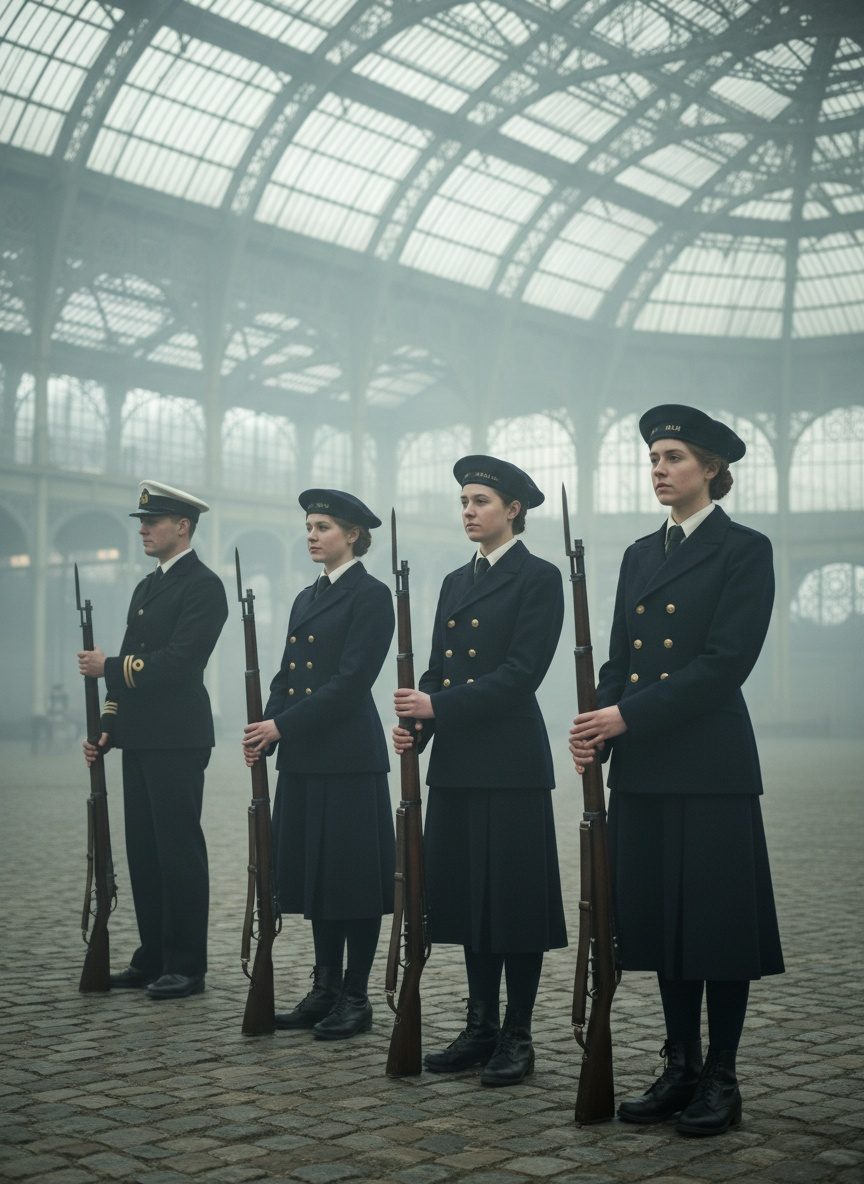
The November chill settled over London like a blanket of fog, weaving through the skeletal ironwork of the Crystal Palace, making the air sharp and bracing. Lamp posts cast long, wavering shadows across the grounds, their lights dim and flickering against the vast Victorian edifice that towered above the cityscape. As if mimicking the stern resolve of its occupants, the historic venue stood fiercely, having traded its reputation as a dazzling exhibition hall for the sound of boots pacing rhythmically over the moistened ground. Here, in the heart of this architectural marvel, something unprecedented was unfolding—Britain's very own revolutionary front in the First World War. It was the birth of the Women's Royal Naval Service, and the stakes could not have been higher.
In the late months of 1917, the cries of war bore heavily on Britain's shoulders. Men were on the front lines in Europe, facing unimaginable horrors, while those who remained at home were spread thin across essential industries. The Navy, Britain's mighty maritime force, found itself stretched perilously close to breaking. The solution emerged not in yet more men but through an extraordinary mobilization of women. Against a backdrop of skepticism and hesitation, nearly 3,000 women, the resilient Wrens, emerged to fill critical roles that men had traditionally claimed as their own.
The Women's Royal Naval Service was more than just a designation; it was a bold step into a realm where women had never officially been invited—not in uniform, anyway. Crystal Palace became the staging ground for this audacious leap. The air was filled with a restless sense of potential as these women, clad in their navy-blue uniforms, wielded rifles with stern determination. Though their initial roles were not intended to thrust them into direct combat, they underwent rigorous training, ready to defend themselves and their nation should the moment demand it. The vision was clear: the Wrens would support and sustain the Royal Navy in more than 100 roles, ranging from cooks and clerks to cryptographers and wireless telegraphists.
The palpable, often unspoken expectation that women were unsuited for such duties dissolved as days turned into weeks. Under the Gothic spires and wrought iron beams, these pioneering women developed skills and forged paths in areas previously deemed unladylike. The rhythmic tap of typewriters echoed alongside the melodious beeps and blips of Morse code, as Wrens operated communications equipment with astonishing dexterity. Tactical wits were honed as women became radar plotters, reading and translating information crucial to the Navy's maneuvering. Even the scent of oil and grease became familiar as women took on roles as mechanics, an image as unexpected as it was empowering.
Shattering conventions did not come without resistance. Critics abounded, questioning both their ability and their presence. Yet the resilience of these women, their quiet dignity under such pressure, turned skepticism to admiration. A snapshot of 1918 captures the steady gaze of Josephine Carr, the first Wren to die in active service, her eyes reflecting a nuanced blend of pride and determination. It was this ethos that underscored every task they undertook, allowing the Royal Navy to maintain its seaworthiness during some of the war’s darkest days.
The roles of the Wrens came as a revelation during a period when Britain was grappling with more than the war's external threats. Internally, the very fabric of society trembled at the thought of women stepping beyond their designated domestic spheres. Yet here at the Crystal Palace and beyond, they stood as stark defiance against outdated norms. The Wrens were more than filling quotas—they were challenging perceptions, rewriting the narrative of what a woman's place in wartime affairs could be.
As crucial as their operational roles were, the significance of the Wrens lay also in the cultural shift they precipitated. The conviction that women could perform admirably in traditionally male-dominated roles outpaced even the skepticism of the most ardent critics. This shift was not momentary but set ripples into motion that would influence future engagements of women in the armed forces.
By the end of the war in November 1918, the Women's Royal Naval Service boasted 5,500 members, of which 500 were officers. Their contributions varied broadly, and some Wrens, including 2,867 former Royal Naval Air Service supporters, chose to transition into the newly established Royal Air Force. These transitions symbolized another frontier conquered, another space where women had proved not just competent but indispensable.
The legacy of the Wrens began under the shadow of threat and necessity but evolved into a testament of enduring bravery and ability. Their service temporarily ceased in 1919, tagged to given wartime exigencies, only to be reinstated with the coming of the Second World War and continued thereafter until full integration into the Royal Navy in 1993. The tale of the Wrens is a striking reminder of how crises can sometimes accelerate progress, pulling society, albeit reluctantly, into more inclusive and egalitarian realms.
As the war ebbed and the Crystal Palace resumed its role as a cultural landmark until its tragic end in 1936, the tales within its walls captured the heart of a nation and changed it. The story of the Wrens and their audacious pick-up of the Royal Navy's reins at the Crystal Palace in 1917 is more than a footnote in history. It was a turning point—a moment when necessity demanded a broadening of horizons, a questioning of stale traditions, and began to redefine the role of women in Britain and beyond. That their story is sometimes left out of the textbooks does not diminish its impactful resonance. Rather, it compels us to peer into these untold legends, understanding that sometimes, salvation comes not from usual suspects but those willing to step beyond conventional thresholds when their world depends on it.