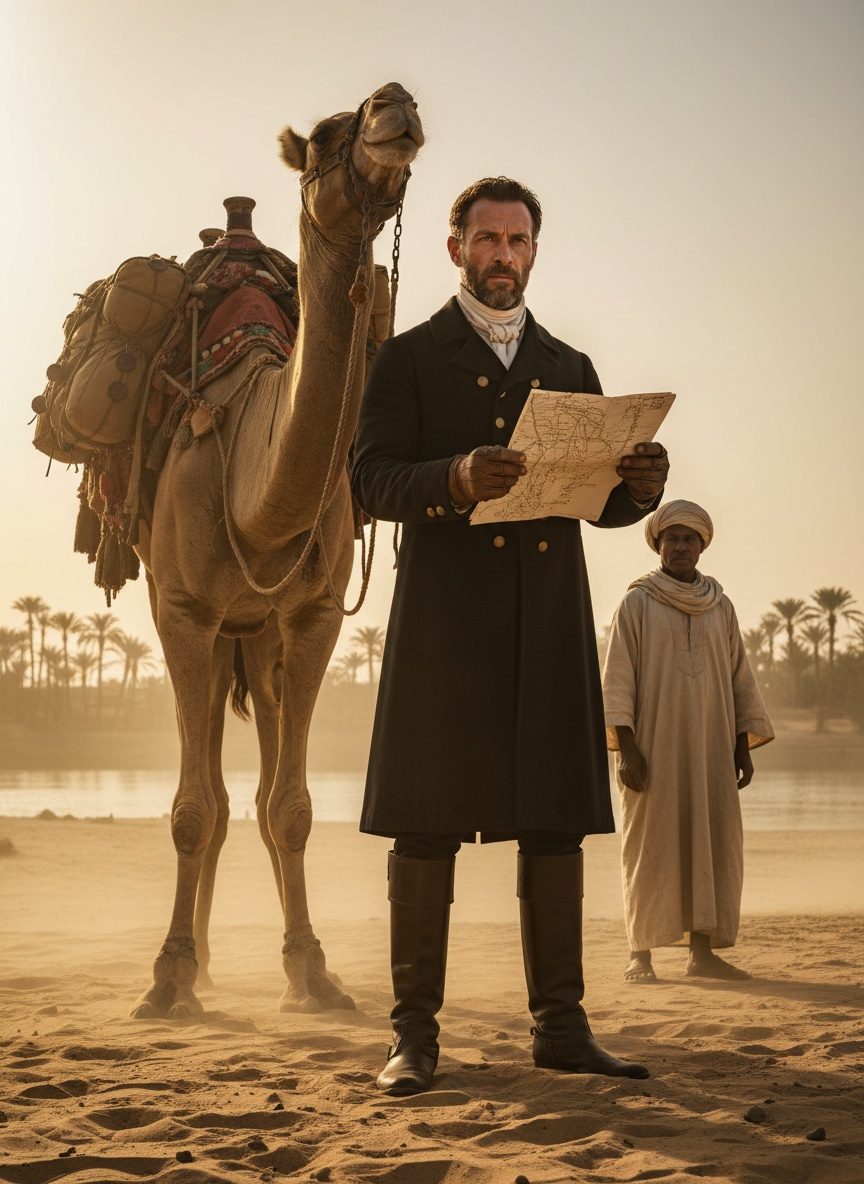
1835. A sea of golden dunes stretched out, shimmering under the relentless Egyptian sun.
The Slow Chain of Letters
In the early days of Queen Victoria's reign, the British Empire's communication lifeline with India dragged painfully slow around Africa's southern reach—the Cape of Good Hope. Round the Cape, letters and dispatches spent upwards of six months fighting tumultuous seas and unpredictable winds before finding their way to Bombay's eager shores. For the countless merchants, officials, and families whose lives hinged on news from the continent, this delay was an interminable torment. It was within this climate of frustrated patience and longing that a spirited postal officer named Thomas Fletcher Waghorn determined to rewrite the rules.
A man of unstoppable conviction, Waghorn imagined a world where the hemispheres were drawn closer by a thread of efficient correspondence. Prior attempts to establish an overland route across Egypt had been overlooked, deemed impractical, or outrightly dismissed. Waghorn, however, was not deterred. His plan was audacious and precise: he would slice through the North African terrain, crossing to India not by the lonelier maritime leagues, but through an arduous traverse that would combine camel's back and steamboat. For an empire accustomed to the ocean's vastness, this was revolutionary.
Waghorn's vision rested on exploiting the thin stretch of land that separated the Mediterranean Sea from the Red Sea, traversing the sands of Egypt before entrusting mail to a quick voyage onward across India. Few understood the urgency—or the reward. Yet Waghorn was determined to demonstrate his resolve not through maps or speeches but by leading the journey himself, spurred onward by the urgency of each undelivered letter.
The Journey Across the Sands
It was a journey that demanded grit, sweat, and uncanny persistence. Waghorn embarked on his overland passage, braving the harshness of Egypt with a resolve as steadfast as the pyramids against the horizon. His journey combined ancient and modern: the camel caravan carried him where no tracks laid, but it was interspersed with the more modern convenience of steam-powered vessels on the Nile.
The journey was perilous. Under the hot Egyptian sun, Waghorn covered the ground between Alexandria and Suez—a distance that would have dissuaded lesser men. The daytime could not be wasted, while the desert's cool evenings offered precious respite. Nights sounded of myriad threats: the shifting sands whispering danger, echoing with the calls of desert wildlife and the distant howl of the wind.
To the local tribesmen, this lone foreigner racing against the Empire's schedule seemed a peculiar sight. Yet, it was this unfamiliar landscape and its unyielding inhabitants that Waghorn adapted to with cautious respect. His singular mission wove him into Egypt's daily tapestry, part explorer, part diplomat, negotiating a passage rooted in mutual understanding.
Crossing the desert by foot or astride a camel transported Waghorn deeper into a history untouched by time. The weathered trackways he followed had been used by traders long ago, paths that predated the empire's needs yet would soon redefine them. As he pressed onward, Waghorn held onto the profound belief that his journey, though solitary, would eventually be traversed by thousands bearing the Empire's words and goods.
The Ripple of Change
Waghorn's labor bore fruit. After days and nights that meshed into an experience both grueling and transformative, he reached the end of his desert-crossing quest. The relentless dedication grew into a network more rapid than any before. Waghorn returned not with fanfare, but with proof—a definitive logistic solution that would cut months into weeks and cost into efficiency. The British Empire's communications had found a new artery.
The route, forged through Waghorn’s perseverance, revolutionized postal services between Britain and its colonial territories. No longer condemned to the maritime world's mercy, the new mail path promised brevity and certainty. Its success heralded dramatic shifts in trade and diplomacy, the mails now capable of uniting continents with a speed previously confined to dreams.
Waghorn's journey was an act beyond navigation—it was a daring stroke that threaded an empire’s many voices together, allowing commerce and culture to move along its lengths with a new rhythm. The course blazed by his determination became a foundation upon which later enthusiasts and engineers would build the larger and grander Suez Canal, further making the dreams of intercontinental unity a reality. His relentless act illuminated paths beyond geography, charting courses for ideas and innovations.
To the modern onlooker, Waghorn's journey across Egypt might appear quaint amidst the technological marvels of instant communication we enjoy today. Yet, it sows a fertile remembrance: that progress is often achieved not through ease or certainty, but through the relentless pursuit of a vision that others have yet to discern. Waghorn's endeavor is a testament to the profound power of tenacity, marking a moment when one man's traverse across desert sands irrevocably bent the arc of history towards a swifter future.