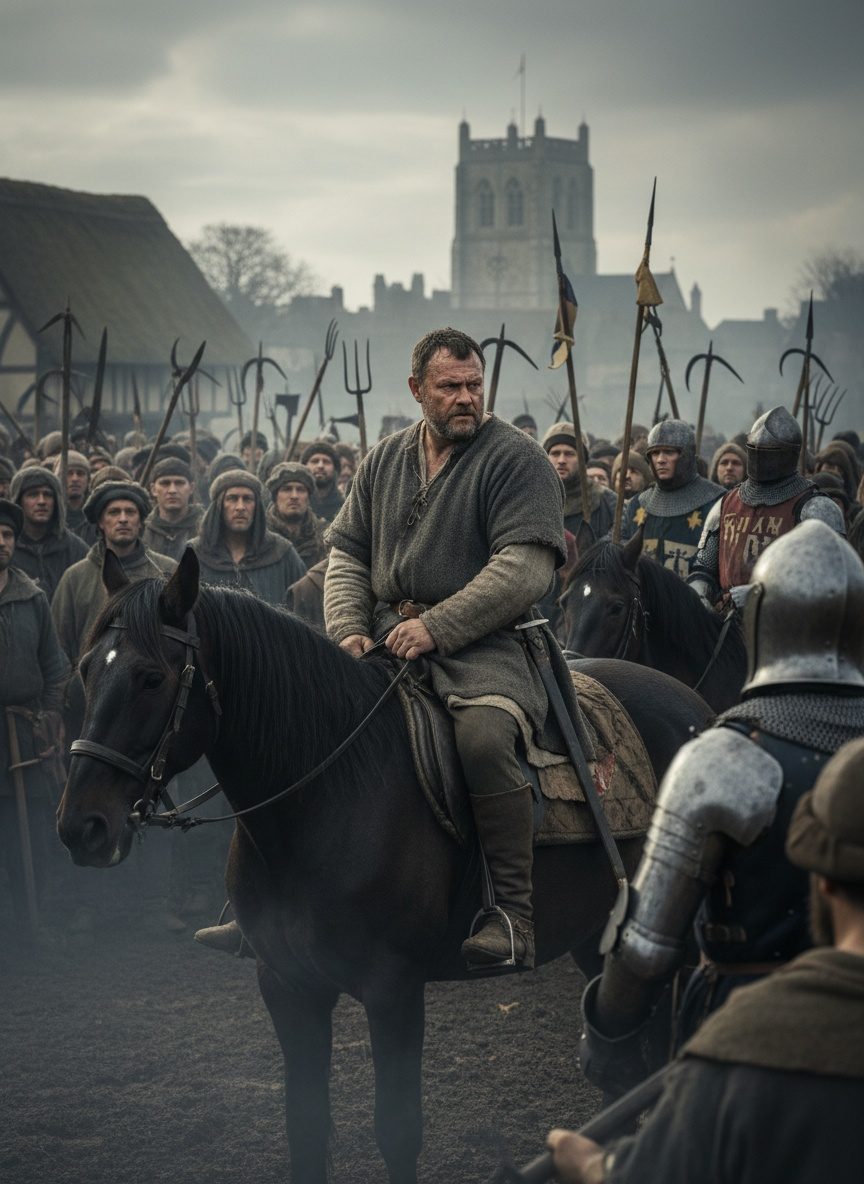
The air over Smithfield in June 1381 was thick with the promise of rain, but the gathering clouds couldn't dampen the tension on the ground. Thousands thronged the fields, restless beneath a sky charged with thunder. Stalls and vendors that normally filled the place had retreated in the face of an entirely different kind of market day — one where the stench of rebellion rose above the fodder and dust. The stakes were no longer just for barter; they were for the soul of England. Wat Tyler, a man with nothing more than common hands and a fire in his gut, was about to stand before a king.
The Gathering Storm
It began in the rural hearts of places like Kent and Essex, where the whisper of revolt grew louder with each passing day of toil and hunger. The poll tax, designed to refill the royal coffers emptied by war, had sown seeds of desperation among the populace. It demanded a fixed sum from every man and woman, reflecting none of the poverty it levied. This was the third such tax in recent years and, for those already struggling to fill their stomachs, it was the last straw.
Leaders emerged not from the titled ranks, but from the plowshares and workshops. Wat Tyler — born with neither land nor pedigree to his name — rose effortlessly as a figurehead, his passion more potent than any knightly vow. In June of that year, the ardent calls for justice swelled into a tide, rippling out from village courtyards to encircle the capital in murmur and might.
London Ablaze
The revolt drove onwards with a fiery will. As the ragged throng surged into London, the frenzy of anger sharpened into an all-consuming torch. Tax records began to burn, each ledger turned to ash a liberation of sorts for the toilers, tangible proof that their grievances could strangle the machinery of oppression.
Their fury unchecked, the rebels breached the Tower of London, a fortified symbol of unattainable authority. Yet amid the chaos, their true victory lay in confronting the very epicenter of governance. It was here that reality spiraled into legend, where the dreams of an embattled populace coalesced around one man's voice.
Facing the Crown
On the field, surrounded by the ebb of boiling revolution, Wat Tyler rode out to meet a crowned boy. King Richard II, merely fourteen, was the living emblem of sovereign legitimacy, but Tyler had charged him with representing the promises that had long gone unfulfilled. Alone, with only a knife sheathed at his side and the weight of unvoiced demands in his heart, Tyler stepped forward.
In a time when the power balance rested heavily on serfdom, a commoner addressing the king was nothing short of revolutionary. To look Richard in the eye was to defy the very marrow of England's feudal spine. As Tyler rode near, every heart at Smithfield thumped in anticipation, each moment a span in which the future balanced precariously.
The Fragile Dialog
The words exchanged at that meeting are as much shrouded in smoke as the events that led to that day. Tyler spoke not just of grievances, but of a vision where equality and fairness rendered oppression moot. This audacity startled the court and kin alike — a peasant dictating terms rather than requesting mercy. Their conversation, though brief, blistered with the heat of truth spoken aloud, an undiluted challenge to the hierarchies that loomed about them.
But such brazen defiance was hazardous, and his boldness swiftly led to a fall. The atmosphere turned electric as the king's men saw the danger inherent in such defiance. A scuffle, a flash of steel, and Wat Tyler's voice was eternally silenced. Yet, silencing a man does not erase the echoes of his words nor douse the flames of rebellion he ignited.
A Legacy Written in Ash
The gathering at Smithfield ended with Tyler's death, but the movement he embodied did not die with him. The uprising quaked with the strength of a thousand voices, each one a sonorous clangor for change that could not be unstruck. In the days that followed, the king granted concessions — an offering to calm the seething restless fires — but the core calls for justice went largely unanswered. Still, the reverberations from that day lingered in the minds and souls of the empire. They sprinkled seeds that would take generations to sprout. More revolts would rise, each echoing the unending dialogue of class and power.
When Wat Tyler rode to meet a king that summer day, he not only pulled back the veil on buried grievances but proved that the disparity between earth and throne was not an unbridgeable chasm. In those few moments at Smithfield, he altered the narrative — demonstrating that common men could indeed face the crowning of power and be heard. It remains a lesson not merely of past confrontations, but a meditation on the voices we choose to heed and the silences we must confront. The tale of Wat Tyler is not just a historical footnote, but a reminder carried on the winds that once swept their field of battle, calling to each generation anew.